
 |
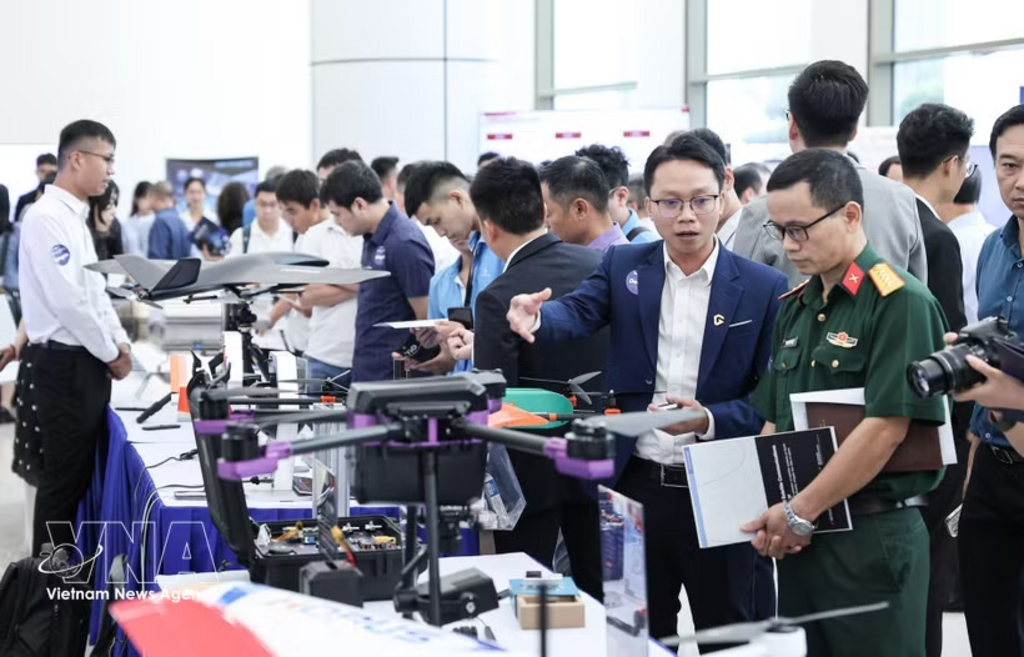
| Delegates visit the exhibition booths at the announcement ceremony of three strategic technology industry innovation networks on August 25, 2025__Photo: VNA |
The Government’s Decree 179/2026/ND-CP, which takes effect on July 15, marks a shift from funding educational institutions to providing scholarships directly to students pursuing basic sciences, key engineering and strategic technology programmes, contributing to developing high-quality human resources in these fields.
Under the decree, students admitted to eligible programmes who meet entrance score requirements or are directly admitted, and rank among the top 30per cent of entrants, will be eligible for Government scholarships. The scholarships will be renewed annually based on academic performance and conduct.
The Ministry of Education and Training has issued the list of eligible disciplines covered by the policy.
The scholarship scheme forms part of broader efforts to expand STEM education, covering science, technology, engineering and mathematics, while improving the quality of entrants to strategic fields.
Nguyen Tien Thao, Director General of the ministry's Higher Education Department, said Vietnam currently has 771,475 STEM students, accounting for about 29 per cent of total higher education enrolment. Of these, 475,833 full-time students are studying in the 15 discipline groups covered by Decree 179. The country aims to raise the share of STEM students to 35 per cent by 2030 to meet the demands of science, technology and innovation.
To achieve this, the ministry is implementing a range of programmes to develop high-quality talent and has approved 90 honours programmes at 23 universities, integrating education with scientific research and strategic technologies.
For the 2025 admissions cycle, about 22,250 students are expected to qualify for Government scholarships from September 1, 2026. In 2026, around 30,000 students are projected to receive scholarships, with annual funding estimated at VND 1.3 trillion (USD 49.53 million).
The policy is also expected to reshape university admissions and training. Professor Nguyen Van Hieu, Vice President of Phenikaa University and Rector of Phenikaa School of Engineering, said Decree 179 could significantly influence students' choices. Science, engineering and technology will increasingly be recognised as strategic fields offering strong career prospects and opportunities to contribute to national development, rather than simply being viewed as difficult subjects. The scholarships are expected to attract more high-achieving students with strengths in mathematics, physics, chemistry, biology and computer science.
Hanoi University of Science and Technology has announced an enrolment target of 9,700 students across 68 programmes in 2026, including 55 eligible for scholarships under Decree 179. Students enrolled in these programmes will receive monthly financial support ranging from VND 3.7 million to VND 5.5 million, depending on the programme.
At the National Economics University, eligible programmes include data science, artificial intelligence, information systems, information technology, cybersecurity, software engineering, computer science and applied mathematics.
While welcoming the scholarship policy, experts stress that developing high-quality talent also requires coordinated investment tailored to the needs of different disciplines.
Associate Professor Tran Manh Cuong, Vice Rector of the VNU-Hanoi University of Science, noted that although technology and engineering programmes enjoy strong labour market demand, basic sciences and mathematics, despite facing recruitment challenges, remain fundamental to the country's long-term development. He called for continued investment in lecturers, facilities, equipment and laboratories alongside student scholarships to strengthen education, research and scientific talent development.
Minister of Education and Training Hoang Minh Son said solid training in basic sciences and key engineering disciplines would enable graduates to adapt quickly to, master and develop future strategic technologies. He added that the Government's scholarship programme not only enables more students, particularly those from disadvantaged backgrounds, to pursue science and technology studies, but also helps improve training quality and supply the skilled workforce needed for Vietnam's industrial development and strategic technology sectors.- (VNA/VLLF)

