
 |
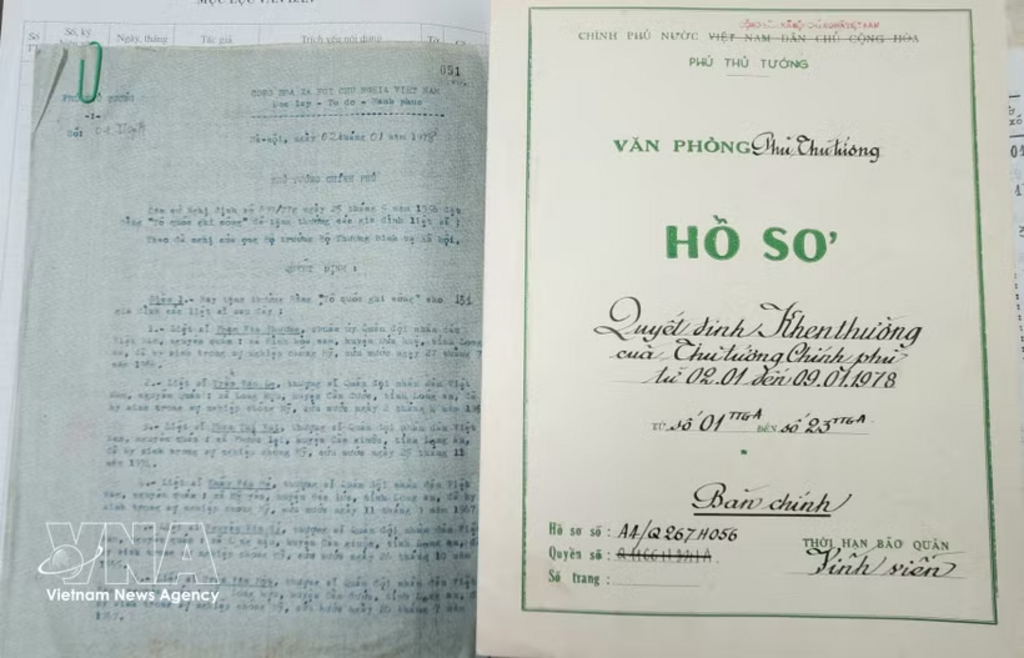
| Documents containing the Prime Minister's commendation decisions awarding the “To quoc ghi cong” (The Fatherland acknowledges the merit) certificate to the families of martyrs, including Decision No. 04TtgA awarding the certificate to the family of martyr Huynh Van Quen__Photo: VNA |
The use of archival materials is providing a great help in the 500-day campaign to intensify the search for, recovery and identification of martyrs’ remains, offering renewed hope to families that have spent decades seeking their loved ones, Tran Viet Hoa, Director of the National Archives Centre No. III under the State Records and Archives Department of the Ministry of Home Affairs told the Vietnam News Agency.
Hoa said the centre preserves a vast collection relating to war invalids, martyrs and cadres deployed to the southern battlefields (B-zone), including personal files and policy documents that reflect the Party and State’s approach to people with meritorious service over different periods, including records showing President Ho Chi Minh’s special concern for this work.
The materials include applications for martyr recognition, files for the granting of the “To quoc ghi cong” (The Fatherland acknowledges the merit) certificate, commendation records, and directives and verification documents from ministries, sectors and localities. They show that martyr recognition had been conducted through a rigorous and multi-level process.
For families and authorities lacking sufficient evidence, the centre provides an important source of original State records for comparing and verifying information, she noted.
According to the official, the centre manages more than 400 archival fonds with nearly 14,000 metres of shelves of records created by central agencies, ministries, sectors and organisations. The collection covers policies for people with meritorious service, martyr recognition, commendations, military campaigns and battles, battlefield support, and related policy implementation. Files relating to Heroes of the People’s Armed Forces include achievement reports and combat records, most of them in the State Presidential fonds.
She highlighted the centre’s collection concerning about 72,000 B-zone cadres, which includes original curricula vitae, personnel forms, Party membership cards, transfer decisions, volunteer applications to go to the South, diaries, letters, photographs, medals and orders. These records form an invaluable source for verifying information about martyrs and their relatives.
Since the 500-day campaign started on March 15, 2026, and at the request of Steering Committee 515 for the search for, recovery, and identification of martyrs' remains, and other agencies, the centre has reviewed about 100 paper files and photographic records from the fonds of the National Assembly, the Presidential Office, the Prime Minister’s Office and various ministries and sectors. The review has also covered major campaigns and battles, including the Ho Chi Minh Campaign, the 1968 General Offensive and Uprising, and the 1972 Spring – Summer Campaign, to support identity verification.
As an initial result, the centre has provided three sets of documents for Steering Committee 515 for data analysis, including records related to the verification of the identities of martyrs buried in a collective grave at Le Thi Rieng Park in Ho Chi Minh City.
Hoa said every timely piece of information could provide another basis for confirming a martyr’s identity and help fulfil the wishes of families that have waited for decades.
Explaining the management of martyr records, Hoa said the files are organised according to archival principles, meaning by the agency that created them rather than under a separate “martyr” category. Files concerning the granting of the "To quoc ghi cong" certificate are kept in the Prime Minister’s Office or Government Office fonds, while commendation records are preserved in the fonds of relevant authorities. This system enables archivists to locate files quickly and accurately.
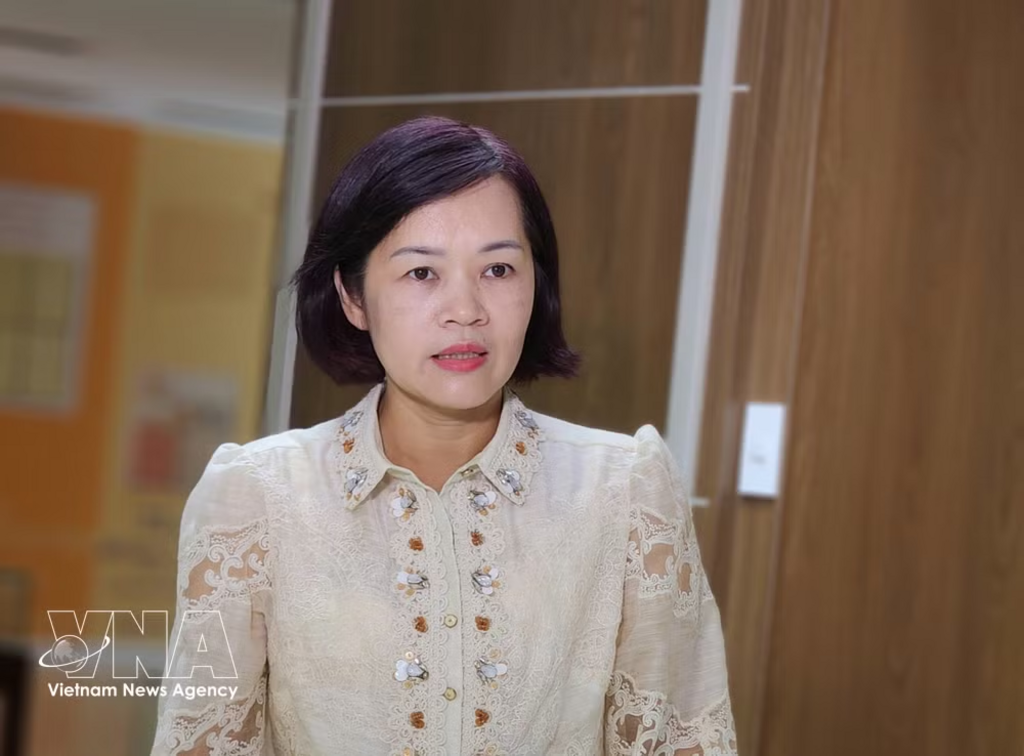 |
| Tran Viet Hoa, Director of the National Archives Centre No. III under the State Records and Archives Department of the Ministry of Home Affairs__Photo: VNA |
Regarding the widely discussed case of martyr Huynh Van Quen, she said that after receiving a verification request concerning relics discovered in a collective grave at Le Thi Rieng Park, centre staff searched the archival system and found a relevant file in the Prime Minister’s Office fond in less than 15 minutes.
She said the information was immediately transferred to the Ministry of National Defence for comparison with battle records and other sources. While the final conclusion rests with the competent authorities, locating the original file so quickly provided an important basis for verification. For archivists, every file found is also a source of hope for families seeking information about their relatives lost nearly six decades ago.
The official noted that the centre has not yet compiled statistics by individual martyr because records are counted according to archival practice, such as by fonds, shelf length, number of files and number of pages. However, most people officially recognised by the State as martyrs and granted the “To quoc ghi cong” certificate have archival files either at the centre or elsewhere in the national archival system.
She stressed the need to build a specialised database of martyr records. Such a system would replace the current manual process of identifying the year of death, locality and decision issuing agency before tracing records through the archives, making searches much faster and more comprehensive, similar to the existing database for B-zone cadre records.
Requests for information increase sharply around War Invalids and Martyrs’ Day (July 27), Hoa said. In addition to serving readers at the reading room, the centre receives requests by email, social media and other online channels. Many families seek B-zone files and keepsakes, martyr information, decisions granting the “To quoc ghi cong” certificate, and records of medals and orders. Even with limited initial information, staff swiftly check and compare records to determine whether relevant files exist, and many families have found information they had sought for years.
On the greatest challenge facing the centre, Hoa said that many records remain undigitised, so most searches must still be conducted manually.
Therefore, she said digitisation is one of the centre’s key priorities. Part of the B-zone cadre collection was digitised in previous years, work is continuing this year, and the centre aims to complete the entire task next year. A portion of the martyr-related records has also been digitised although the work is carried out by archival fonds rather than by separating martyr files, making the workload enormous.
She added that technologies such as artificial intelligence (AI) can support data processing, but final verification must still be carried out by professional archivists to ensure accuracy and legal validity. Once digitisation is completed and a unified database is established, searches will become much faster and more accurate, providing an important foundation for the search for, recovery and identification of martyrs’ remains and for better implementing policies for people with meritorious service.- (VNA/VLLF)

