Philippe Troussier has been appointed coach of the Vietnamese U19 team, the Vietnam Football Federation (VFF) announced on September 10.
Philippe Troussier has been appointed coach of the Việt Nam U18 team. (Photo: qdnd.vn)
Hanoi(VNA) - Philippe Troussier has been appointed coach of the Vietnamese U19 team,the Vietnam Football Federation (VFF) announced on September 10.
The 64-year-oldFrenchman will lead Vietnam in the 2020 AFC U19 Championship qualifiers.
Vietnam are in GroupJ alongside Japan, Mongolia and Guam of the event which will start on November2. Vietnam will be playing their first match against Guam on November 6.
To prepare for the tournament, Troussier plans to gather the U19 team for training from September 6. The training plan will include the participation in an international U19 event in Thailand from October 10-12 with the presence of Uzbekistan, the Republic of Korea and hosts Thailand.
Troussier has a longpartnership with African football and particularly their nationalteams, managing Côte ’Ivoire, Nigeria, SouthAfrica and Burkina Faso.
He was the head coachof the Japan national team between 1998 and 200, helping the Blue Samurai winthe 2000 AFC Asian Cup and led them in the 2002 FIFA World Cup where they made itto the last-16 as the host nation.
Troussier is alsotechnique director of the Promotion Fund of Vietnamese Football TalentsFootball Club (PVF).-VNA
VNA
Related News
Vietnam U19 female football team failed to find the net during a goalless draw with Thailand in China on May 10.
Head coach of Vietnam’s national football team Park Hang-seo has called 27 players to prepare for the upcoming match against Thailand in the Asian zone’s second qualifying round for the World Cup 2020.
Prime Minister Nguyen Xuan Phuc has called the national football team to show them his support ahead of the 2022 FIFA World Cup qualification match in Thailand on September 5.
A highlight of Kids Fest 2026 is an interactive experience zone inspired by a Rubik's Cube, with six colourful sections representing creativity, arts, sports, knowledge, the environment, and family and global integration.
The festival is part of Hanoi's strategy to boost its cultural industries by transforming cultural heritage into a driver of socio-economic development while preserving and promoting the city's traditional cultural values.
The showcased works present diverse perspectives on a peaceful, stable and dynamic Vietnam where human rights are respected, protected and promoted.
Digital technology is showcasing the World Cultural Heritage site of My Son Sanctuary, enabling visitors to experience its historical and cultural significance while supporting long-term conservation. The site's authenticity is being preserved through scientific restoration and digital transformation, enhancing the visitor experience, and promoting sustainable tourism.
The festival, running from April to December, features a wide range of commemorative, cultural, artistic, sporting, tourism, investment networking, trade promotion and community activities carrying messages of peace, friendship and development.
“Vive la Paix” (Long Live Peace) painting was created by Spanish artist Pablo Picasso in 1954 following the signing of the Geneva Accords and was published on the front page of the French newspaper L’Humanité. While Picasso’s famous peace dove appears prominently in the painting, he also added images of people wearing Vietnamese conical hats alongside landscapes reminiscent of Vietnam.
Artistic director and international classical solo musician Hang Nguyen from the Da Nang-based Mun Art Academy said the competition will open at the Muong Thanh Luxury hotel, with a gala concert From Heritage to Harmony, a Journey across Cultures starting at 7.30pm on June 26.
Vietnamese Consul General Nguyen Viet Kien stressed that cultural exchange activities serve as a powerful bridge connecting people and strengthening bonds among different communities in Artyom.
The celebrations will feature five high-altitude fireworks sites combined with low-altitude displays, together with low-altitude fireworks at 11 additional locations to serve residents and visitors across the city.
At the centre of the scene, more than 1,000 traditional conical hats were arranged to form a giant teapot and a tea blossom – familiar symbols of Vietnam’s tea culture.
The additional seating in Grandstand A4 will be put into operation ahead of schedule to meet growing demand from both local residents and tourists eager to enjoy one of Vietnam’s most anticipated summer events.
At a press conference held in Hanoi on the afternoon of June 22, organisers said the competition is expected to welcome approximately 15,000 participants competing across the four distances of 42km, 21km, 9.2km and 2.9km.
Over the past decade, Trang An has become a successful example of development that regards culture as both a driving force and an objective while placing people at the centre of all development efforts.
Nguyen Thi Dieu Ly defeated Kama Tsubasa of Japan 5–1 to take the title in the women's 68kg class, helping Vietnam complete its target at the continental tournament.
The main festival activities will take place from July 17-19 in Nha Trang, while related events will be held across the province from July 10 to August 10.
More than an annual sporting event, this year’s tournament has become a symbol of the resilience, solidarity and growing strength of the Vietnamese community in Russia.
Quartet Ta Ngoc Tuong, Vu Ngoc Khanh, Tran Dinh Son and Le Ngoc Phuc stunned onlookers with their win in the men's 4x400m event.
The festival aims to showcase the cultural and tourism values of Thang Long – Hanoi, honour the beauty and significance of the lotus in Vietnamese life, and promote lotus-based products as part of efforts to boost the capital’s cultural and tourism industries.
Vietnam’s cultural industries currently comprise around 70,000 active enterprises, generating employment for more than 3 million workers and contributing an estimated 2.5–3% of GDP. Several localities have also developed creative ecosystems, innovation hubs, and effective cultural economy models.
Among the province’s success stories is Ta Phin commune, one of Lao Cai’s earliest community-based tourism destinations and a locality renowned for its diverse traditional occupations that provide stable and sustainable livelihoods for ethnic minority communities.

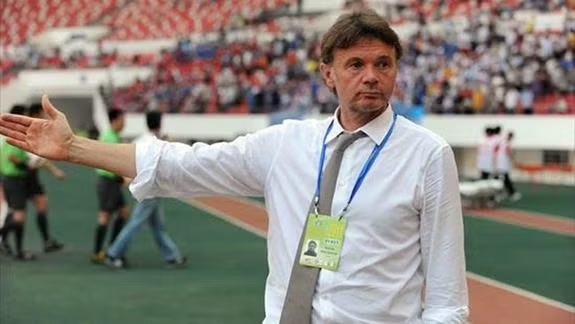
 Philippe Troussier has been appointed coach of the Việt Nam U18 team. (Photo: qdnd.vn)